Rare earth elements (REEs)

Rare earth elements (REEs)

What are rare earth elements?

Rare Earth Elements (REEs) are a group of 17 chemically similar metallic elements that have been mined and utilized globally for over 70 years. They are essential raw materials for modern technology, widely used in everything from electric vehicles (EVs) and wind turbines to smartphones, computers, and other high-tech products.

According to the U.S. Department of Energy’s (DOE) 2023 Final Critical Materials List, four REEs are classified as most critical due to their essential role in clean energy technologies and high supply chain risks:

  • Dysprosium (Dy)
  • Neodymium (Nd)
  • Praseodymium (Pr)
  • Terbium (Tb)

Meanwhile, the European Union’s Critical Raw Materials Act, which came into force on May 23, 2024, designates all 17 rare earth elements as critical, underscoring their importance in industrial and technological applications worldwide.

Location

Light vs. Heavy Rare Earth Elements

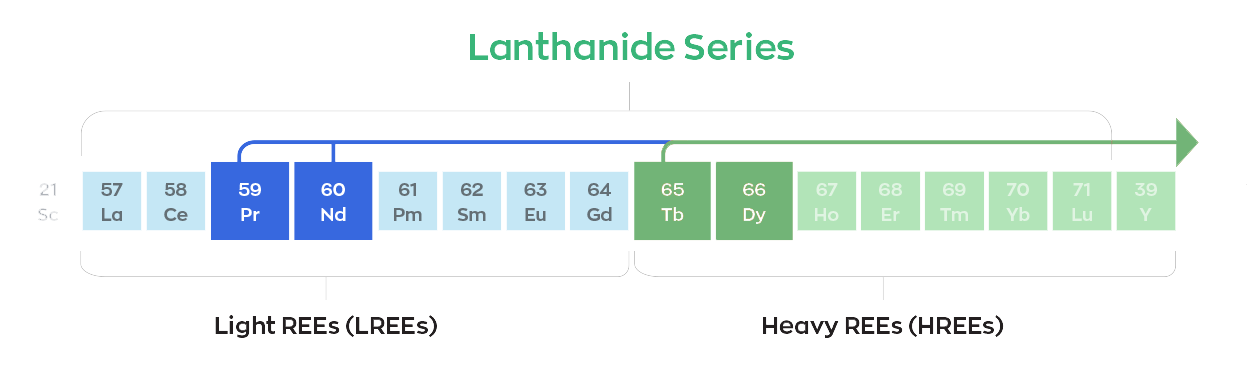
Rare earth elements are categorized into two main groups:

1. Light Rare Earth Elements (LREEs): “Light” refers to their atomic structure, not physical weight. LREEs are more abundant in nature, typically found in hard-rock deposits, and generally less expensive than heavy REEs due to their wider availability.

  • LREEs include: La (Lanthanum), Ce (Cerium), Pr (Praseodymium), Nd (Neodymium), Pm (Promethium), and Sm (Samarium).
  • Key importance: Neodymium (Nd) and Praseodymium (Pr) are vital for producing NdFeB permanent magnets, the strongest type of magnet used in EV motors and wind turbines.

2. Heavy Rare Earth Elements (HREEs): HREEs are crucial for high-performance magnets used in electric vehicles, wind turbines, and advanced defense systems. They are typically extracted from ionic clay deposits, which are geologically rare, resulting in limited supply and higher market value.

  • HREEs include: Gd (Gadolinium), Tb (Terbium), Dy (Dysprosium), Ho (Holmium), Er (Erbium), Tm (Thulium), Yb (Ytterbium), Lu (Lutetium), and Y (Yttrium).
  • Key importance: Terbium (Tb) and Dysprosium (Dy) are particularly valued for enhancing magnet performance at high temperatures, making them strategically critical and highly priced.

Supply and Scarcity: Most of the world’s heavy rare earth elements (HREEs) have historically been sourced from ionic clay deposits, which are geologically rare and environmentally sensitive to develop. This scarcity, combined with their strategic industrial value, makes HREEs significantly more valuable than LREEs.

Location

Applications of Rare Earth Elements

Dysprosium

Dysprosium (Dy) (Heavy Rare Earth)

Key Role: Enhances the high-temperature performance of NdFeB magnets.

Applications:

  • Electric vehicle (EV) motors
  • Military-grade high-sensitivity sensors
  • Wind turbines operating in extreme environments
Terbium

Terbium (Tb) (Heavy Rare Earth)

Key Role: Improves magnet stability and efficiency at high temperatures.

Applications:

  • Green energy technologies (e.g., wind turbines)
  • Advanced precision sensors
Neodymium

Neodymium (Nd) (Light Rare Earth)

Key Role: Core material for neodymium–iron–boron (NdFeB) magnets — the strongest type of permanent magnet.

Applications:

  • Electric vehicle motors
  • Wind turbines
  • Hard disk drives
  • Headphones and other electronic devices
Praseodymium

Praseodymium (Pr) (Light Rare Earth)

Key Role: Commonly alloyed with neodymium to enhance magnetic strength and heat resistance.

Applications:

  • Electric vehicle motors
  • Wind turbines
  • Aircraft engines

Global Rare Earth Elements (REE) Reserves and Production (2024)

Reserve

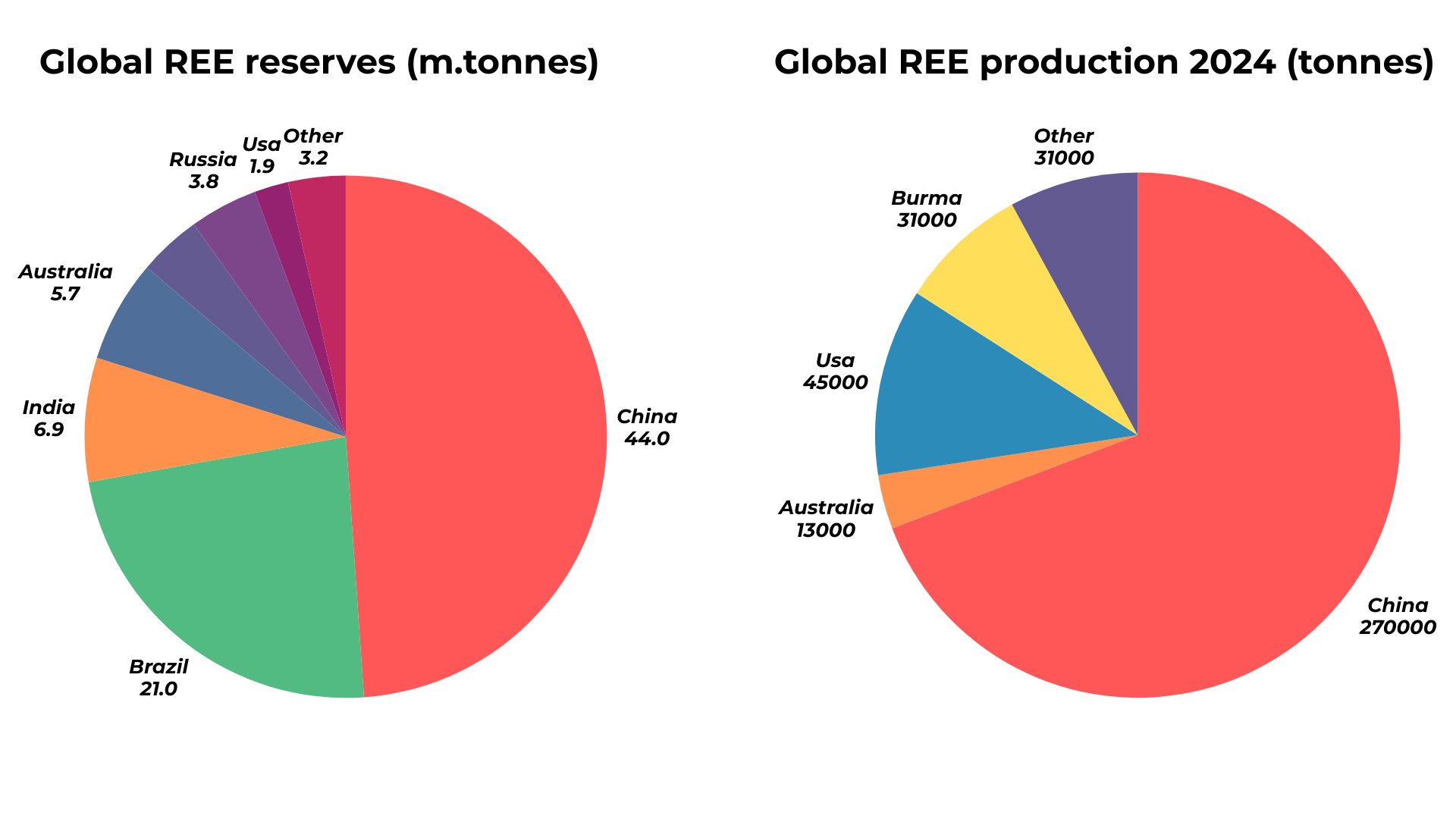
As of 2024, global rare earth element (REE) reserves are estimated at approximately 90 million tonnes of rare earth oxide (REO) equivalent. China holds the largest share, with around 44 million tonnes, followed by Brazil (21 million tonnes), India (6.9 million tonnes), Australia (5.7 million tonnes), Russia (3.8 million tonnes), and Vietnam (3.5 million tonnes). The United States and Greenland also possess smaller but strategically significant reserves. These figures represent deposits that are technically and economically feasible to extract under current conditions. As exploration activities expand, the total estimated reserves are expected to increase.

Production

In 2024, global REE production reached approximately 390,000 tonnes of REO equivalent. China continues to dominate output, accounting for the majority of global supply. Other major producers include the United States (~45,000 tonnes), Myanmar (~31,000 tonnes), and Australia (~13,000 tonnes), with Nigeria and Thailand contributing smaller but notable volumes.

production

Although reserves are widely distributed across the world, processing and separation capacity remain heavily concentrated in China, leaving the global supply chain vulnerable to market and policy disruptions.

Global REE Market Overview

The global rare earth elements (REE) market was valued at around USD 5.62 billion in 2024 and is projected to reach USD 6.25 billion by 2025, reflecting a compound annual growth rate (CAGR) of about 11.2%.

Other forecasts suggest the market could expand from USD 3.75 billion in 2024 to nearly USD 9.91 billion by 2034, indicating sustained demand growth across multiple sectors.

Key Demand Drivers

  • Clean Energy Transition: Rapid adoption of electric vehicles (EVs), wind turbines, and renewable energy systems continues to drive demand for REEs, particularly neodymium (Nd), praseodymium (Pr), and dysprosium (Dy).
  • High-tech Applications: REEs are essential in permanent magnets, advanced electronics, robotics, and defense technologies, which remain key demand sectors.
  • Market Composition: Light rare earth elements (LREEs) dominate the market, accounting for nearly 80% of total consumption.

Supply Landscape and Challenges

  • China’s Dominance: China remains the world’s leading producer and processor of REEs. In 2024, its exports rose to 55,431 tonnes, though export revenues declined due to lower global prices.
  • Concentration Risks: Despite geographically diverse reserves, refining and separation capacity are still highly concentrated in China, making global supply chains susceptible to geopolitical and market risks.
  • Global Response: Countries such as the United States, Australia, and the European Union are investing in domestic mining, refining, and recycling projects to diversify supply sources and reduce dependency on China.

Trends and Future Outlook

  • Sustained Growth: Driven by clean energy expansion and advanced technologies, the market is projected to maintain a CAGR of 5%-6% through 2030.
  • Strategic Projects: Governments are implementing critical mineral strategies, establishing national stockpiles, and investing in downstream processing capacity to strengthen supply security.
  • Innovation & Recycling: Advances in recycling technologies and high-efficiency extraction methods are expected to play an increasingly important role in meeting future REE demand.